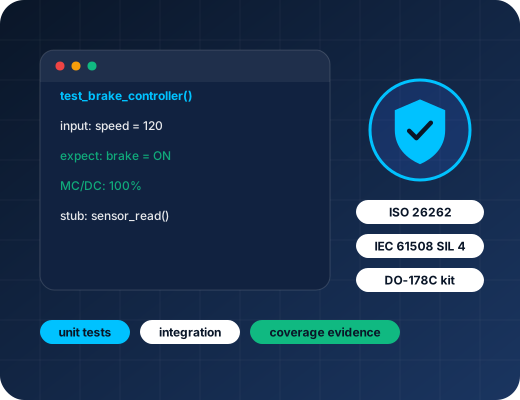
Ask any embedded or safety-critical software engineer about unit testing and you'll hear a familiar story: "We know we should do more of it, but we simply don't have time." Manually writing test stubs for complex C/C++ code is painstaking. Setting up a test harness that can isolate the hardware dependencies is an engineering project in itself. And then there's coverage analysis, results traceability, and certification evidence generation on top.
This is precisely why so many safety-critical software teams ship code with inadequate test coverage - and why Cantata exists.
The Unit Testing Gap in Safety-Critical Development
Unit testing for safety-critical embedded software is fundamentally different from unit testing a Python web service. You're testing code that directly controls physical processes - engine management, braking systems, infusion pump dosing, flight control surfaces. A missed edge case isn't a user experience problem; it's a safety incident.
The certification reality: DO-178C, ISO 26262 and IEC 61508 each define structural code coverage expectations, including MC/DC, that become stricter as the software's design assurance level, ASIL or safety integrity level rises. Demonstrating this coverage by hand, across a large C/C++ codebase, is a substantial engineering effort - which is why teams turn to automated tools such as Cantata.
What Cantata Does - And Why It's Different
Cantata by QA Systems is a purpose-built test automation tool for C and C++ - not a generic unit testing framework adapted for embedded use. It understands the constraints of embedded development: hardware dependencies, complex build systems, memory-mapped registers, interrupt-driven architectures, and safety standard requirements.
Automated Test Stub Generation
The biggest time sink in unit testing is creating stubs - stand-ins for functions that a unit depends on but that you don't want to execute during isolated unit testing. Cantata analyses your code and automatically generates stubs, isolates and wrappers for the dependencies of the unit under test, allowing you to test each function in isolation.
MC/DC Coverage That Satisfies Certification Bodies
Modified Condition/Decision Coverage (MC/DC) is a structural coverage metric used in safety-critical software testing: it checks that each condition inside a decision has been shown to independently affect that decision's outcome. Cantata measures MC/DC coverage, using both unique-cause and masking variants, identifies which conditions still need test cases to reach the target coverage, and includes the results in the certification evidence package.
Get a 14-day free trial with expert onboarding from SecOpsTool, or compare it with the alternatives first.
Requirements Traceability: The Certification Evidence Chain
Safety certification bodies don't just want to see that you tested your code - they want to see that every requirement is covered by at least one test, and that every test maps back to a requirement. Cantata maintains this traceability matrix automatically, linking requirements from ReqIF, Excel, Polarion, DOORs, PTC Integrity or CodeBeamer to Cantata tests with their results status and code coverage information, and generating the evidence package that your DER (Designated Engineering Representative) or TÜV auditor needs.
Integration Testing: Beyond Unit Boundaries
Software defects don't only live inside individual functions - they live in the interfaces between them. Cantata's integration testing capabilities test the interactions between software components, validating that data flows correctly across module boundaries, that timing relationships are maintained, and that combined behaviour meets system-level requirements.
🔒 Try Cantata Free for 14 Days
Full Cantata access for your C/C++ codebase. Our safety-critical testing specialists will help you set up, configure, and run your first automated test suite.
Start My Free 14-Day Cantata Trial →Regression Testing: Catching Regressions the Moment They Happen
In safety-critical development, a regression - a change that breaks previously working functionality - can be catastrophic. Cantata's Code Change Analysis identifies the tests affected by a code or build-option change, so only the relevant subset has to be re-run, and its AutoTest feature can automatically generate test case vectors that exercise code coverage targets while creating regression unit tests.
Certified for IEC 61508, Qualification-Ready for DO-178C
One of the most valuable aspects of Cantata for safety-critical programmes is that it is independently certified rather than something teams must qualify entirely from scratch. DO-178C does not allow tools to be pre-certified - on every project the certification applicant must qualify the tools it uses - but Cantata is a DO-178 categorised tool, and QA Systems provides a Tool Qualification Kit covering software levels A to E for DO-178C and DO-330. For IEC 61508, Cantata itself has been certified by SGS-TÜV as a class T2 tool, usable in the development of safety-related software up to SIL 4, which removes a separate qualification step for that standard.
Safety certification is hard enough without having to build your test infrastructure from scratch. Cantata gives safety-critical development teams the automated testing capabilities they need to achieve the coverage requirements that certification mandates - at the speed that modern development demands.
Sources
Primary documents this article is based on. Product statements and regulatory clauses above were checked against these pages.
- QA Systems - Cantata product page
- QA Systems - Cantata code coverage metrics
- QA Systems - Cantata AutoTest
- QA Systems - DO-178/DO-330 solution page
- QA Systems - IEC 61508 solution page
- QA Systems - ISO 26262 solution page
- QA Systems - Cantata Tool Qualification Kit outline for DO-178C & DO-330
- FAA - Designated Engineering Representatives (DER)
- RTCA - DO-178() Software Standards Documents & Training
- IEC Webstore - IEC 61508-3:2010 abstract