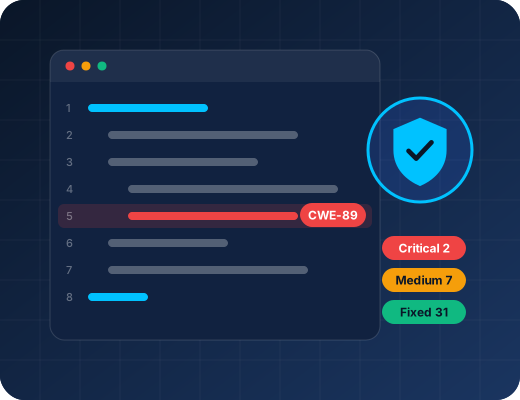
Embedded software powers the world's most critical systems - automotive braking controllers, aircraft flight computers, medical infusion pumps, industrial PLCs. Yet security testing in embedded development has historically lagged years behind enterprise software. A single exploitable vulnerability in a connected vehicle or medical device can cause consequences that go far beyond data breaches - they can cost lives.
This is where Static Application Security Testing (SAST), and specifically Klocwork, becomes not just useful but non-negotiable.
Why Embedded Systems Present a Unique Security Challenge
Embedded software operates under severe constraints: limited memory, real-time execution, bare-metal C/C++, hardware-software co-design. Standard SAST tools built for Java or Python simply don't understand MISRA C, can't reason about hardware register access patterns, and generate overwhelming false positives on embedded code. Security teams often abandon them, and much embedded firmware ships with little meaningful static analysis.
Why this matters: C and C++, the dominant languages in embedded firmware, provide no built-in protection against reading or writing outside an array's boundaries. The weaknesses that stem from this, including buffer overflows, are consistently ranked among MITRE's CWE Top 25 Most Dangerous Software Weaknesses.
What Klocwork Does Differently
Klocwork performs deep semantic analysis of C, C++, Java, and Python - understanding how code executes, not just how it's written. It ships with built-in checkers for MISRA C 2012, MISRA C++ 2008, AUTOSAR C++14, CERT C/C++ and CWE Top 25 - the coding standards that matter in embedded, automotive, and industrial development. Its CWE, CERT and DISA STIG checkers also map to the secure-implementation requirements in IEC 62443-4-1.
Incremental Scanning for Complex Build Systems
Embedded teams work with CMake, Make, IAR, and Keil. Klocwork integrates natively with these environments and supports incremental scanning - analysing only changed code. A build that takes hours to compile can be scanned for security issues in minutes, making it practical to run on every commit without slowing developers down.
Finding Vulnerabilities That Kill People
Buffer overflows, null pointer dereferences, use-after-free, integer overflows, race conditions - these aren't theoretical in embedded systems. Each of these weakness classes appears on MITRE's CWE Top 25 Most Dangerous Software Weaknesses list, and each is the kind of defect that structural static analysis is designed to catch before firmware ships.
// File: src/can_parser.c | Line: 247 | Severity: CRITICAL
void parse_can_frame(uint8_t *data, int len) {
char buf[64];
memcpy(buf, data, len); // ← KW: len can exceed 64 → OVERFLOW
}
// Suggested fix: if (len > (int)sizeof(buf)) return ERROR_OVERFLOW;
Get a 14-day free trial with expert onboarding from SecOpsTool, or compare it with the alternatives first.
Compliance: ISO 26262, DO-178C, IEC 62443
Safety standards for embedded software set out verification objectives that static analysis tools help satisfy. DO-178C requires structural coverage analysis. ISO 26262-6 requires software unit design and implementation, plus software unit verification. IEC 62443-4-1 requires secure implementation, including coding guidelines, as part of its secure development lifecycle. Klocwork generates qualification evidence that feeds into these certification processes, supporting teams working towards ASIL-D or DAL-A.
CI/CD Integration for Embedded Teams
- Jenkins: Klocwork's command-line tools and API trigger differential analysis on every firmware commit
- GitLab CI: Findings post as merge request comments - devs see issues before code merges
- Jira: Defect details export directly to Jira issues, with a link back to the finding in the Klocwork portal
- IDE plugins: Eclipse, Visual Studio, Wind River Workbench - flags issues before code is checked in
🔒 Try Klocwork Free for 14 Days
Full-featured access for your embedded C/C++ codebase. Our security engineers will set up, configure, and walk through your first scan results with you.
Start My Free 14-Day Trial →What Teams Typically Find in Their First Scan
A first static analysis scan of a previously unscanned embedded codebase typically surfaces defects that manual review missed - buffer overflows, null pointer dereferences, memory leaks and uninitialised variables among them, alongside MISRA C violations in legacy code. That is expected: the code has never been through structural static analysis before.
The question isn't whether your embedded software has vulnerabilities. Every complex codebase does. The question is whether you find them first - or an attacker does.
Sources
Primary documents this article is based on. Product statements and regulatory clauses above were checked against these pages.
- Perforce Klocwork product page
- Coding standards mapped to Klocwork checkers
- What Is IEC 62443? (Perforce)
- ABV.GENERAL checker reference (Klocwork)
- CWE-120: Buffer Copy without Checking Size of Input
- CWE Top 25 Most Dangerous Software Weaknesses
- ISO 26262-6:2018 abstract
- IEC 62443-4-1:2018 abstract
- Jira and Perforce integration (Klocwork Jira export)
- GitLab SAST: Using GitLab With Klocwork