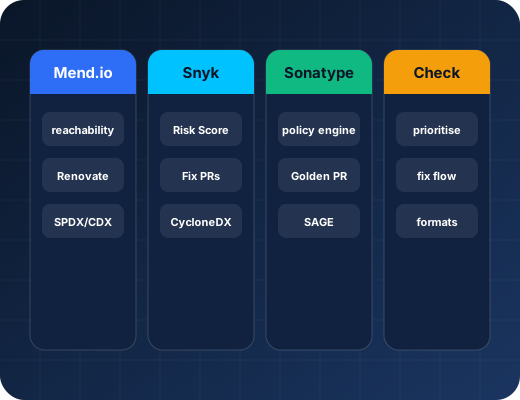
Most applications are now assembled largely from open source components, and OWASP's Top 10:2025 names software supply chain failures - breakdowns or malicious changes in the third-party code, tools and dependencies a system relies on - as a distinct risk category. Software composition analysis (SCA) is OWASP's term for the software-only slice of that problem: identifying risk from the third-party and open source components inside an application. This article compares how three SCA vendors supplied by SecOpsTool - Mend.io, Snyk and Sonatype Lifecycle - describe their own approach to that job, using only what each vendor publishes in its own documentation.
Buyers are also increasingly asked for a software bill of materials. Regulators have been explicit about what a usable SBOM should contain: current US guidance from CISA, updating the 2021 NTIA minimum elements report, frames an SBOM as an "ingredients list" for software, built from Data Fields, Automation Support and Practices and Processes. Those expectations, with OWASP's own component-analysis guidance, are the yardstick used below.
All three products compared here do vulnerability detection, licence-risk detection and SBOM export. Where they differ is in how they prioritise findings, automate fixes, and how each product is sold and deployed. Every fact below is drawn from the vendor's own site or documentation, listed in the sources at the end.
What OWASP and CISA say an SCA tool should deliver
OWASP defines Component Analysis as "the process of identifying potential areas of risk from the use of third-party and open-source software and hardware components," describing Software Composition Analysis as "a software-only subset of Component Analysis with limited scope." OWASP's own description of what this process should identify covers known vulnerabilities from multiple intelligence sources, outdated or end-of-life components, component licences and their restrictions, inventory accuracy, risk inherited through transitive dependencies, and the health of the upstream project.
OWASP's Top 10:2025 adds a dedicated category, A03: Software Supply Chain Failures, defined as "breakdowns or other compromises in the process of building, distributing, or updating software" caused by "vulnerabilities or malicious changes in third-party code, tools, or other dependencies." Its prevention guidance: "centrally generate and manage the Software Bill of Materials (SBOM)" of your software, and "continuously monitor sources like [CVE], [NVD], and [OSV]" using "software composition analysis, software supply chain, or security-focused SBOM tools to automate the process."
OWASP's own SBOM cheat sheet defines an SBOM as a "machine-readable list of components, versions, checksums, and metadata," capturing component name and version, a unique package identifier (purl), package type, a checksum, origin or supplier, licence, timestamps and build identifiers, and relationship edges showing direct versus transitive dependencies. It also flags an easy-to-overlook point: "unsigned SBOMs can be forged," so signing or attestation matters.
Regulators converge on a similar list. CISA's 2026 minimum elements document, which "updates and replaces" the 2021 NTIA report, organises SBOM requirements into three areas: Data Fields, Automation Support, and Practices and Processes. Its baseline data fields, closely paraphrased from the document, include the supplier name, component name and version, dependency relationship, a component hash, other unique identifiers, licence information and known vulnerabilities - the criteria used below.
Mend.io: reachability, licence enforcement and Renovate
Mend.io describes Mend SCA as a tool that "identifies, prioritizes, and remediates security and license risks in the open source components your applications depend on," supporting "more than 200 programming languages and frameworks across major ecosystems," naming JavaScript/npm, Python (pip, Poetry), Java (Maven, Gradle), .NET (NuGet), Go, Ruby, PHP, Rust and Swift, plus container layers and AI frameworks.
Reachability-based prioritisation
To cut the volume of vulnerabilities a team has to act on, Mend's documentation describes a Reachability Algorithm "engineered to assess whether a given vulnerability associated with an open-source library is reachable within the application's source code," aimed at "focusing solely on vulnerabilities that are actually reachable." The method: Mend analyses the imports in an application's source code to identify which classes are used, then builds "a comprehensive relationship graph of these classes and associated files," while stating: "We only upload and cache metadata pertaining to your project, such as file and class names, and do not store any of your actual code."
Licence compliance and SBOM output
Mend SCA "detects every license attached to your direct and transitive dependencies" and lets an organisation enforce a licence policy with "automatic remediation capabilities." Its Dependencies SBOM Report exports SPDX 2.2 or 2.3 (JSON, XML, YAML, Excel or tag-value) and CycloneDX 1.4, 1.5 or 1.6 (JSON or XML); Mend notes that CycloneDX carries embedded VEX (Vulnerability Exploitability eXchange) data, while SPDX does not.
Renovate
Mend also owns Renovate, the dependency-update tool "created in 2017 and acquired by Mend.io (formerly WhiteSource) in 2019." Mend describes it simply: "Mend Renovate automatically detects outdated packages and delivers updates as pull requests." It is offered as a free CLI, a free hosted Community edition, and a paid Enterprise edition.
Get a 14-day free trial with expert onboarding from SecOpsTool, or compare it with the alternatives first.
Snyk: fix pull requests, Risk Score and licence policies
Snyk describes Snyk Open Source as "Advanced software composition analysis (SCA) backed by" its own security and application intelligence. Its supported-languages documentation lists Apex, C/C++, Dart and Flutter, Elixir, Go, Java and Kotlin, JavaScript, .NET (C# and VB.NET), PHP, Python, Ruby, Scala, Swift and Objective-C, and TypeScript, with Rust at a more limited support level.
Risk-based prioritisation
Rather than ranking issues purely by CVSS score, Snyk prioritises with a "Risk Score, by dynamically evaluating vulns for over a dozen objective and contextual factors, including reachability, exploit maturity, and EPSS/CVSS scores." Over 24,000 new vulnerabilities were discovered in 2024 alone, which is why risk-based ranking matters more than a raw count.
Fix pull requests and licence compliance
For projects connected through a source-control integration, Snyk's documentation describes automatic pull-request generation "for vulnerability fixes, package upgrades, and backlog vulnerabilities," combining "Snyk fix advice with the list of remediated vulnerabilities" into a PR a developer can review and merge. On licences, every test in the web UI, CLI or PR checks scans "for vulnerabilities and license compliance," covering direct and indirect dependencies. Its default policy uses two severities: High, for "licenses that definitely present issues for commercial software," and Medium, for "licenses with clauses that may be of concern and should be reviewed." Where a package carries more than one licence, Snyk "displays the severity of the license with the highest severity."
SBOM export
The Snyk CLI's sbom command supports CycloneDX v1.4, v1.5 and v1.6, each in JSON or XML, and SPDX v2.3 in JSON, via both the CLI and the REST API.
Sonatype Lifecycle: policy engine, Golden Pull Requests and air-gapped deployment
Sonatype describes the Lifecycle policy engine as covering security, legal and architectural risk together: it "offers 18 default policies and over 30 customizable constraints," and lets a team "set policies on 2000+ open source licenses" in Sonatype's database. Sonatype states Lifecycle "supports 20+ languages and packages," naming Java (Maven, Gradle), Python (PyPI), JavaScript (npm), Go, Rust (Cargo), C# (.NET/NuGet), Ruby, PHP (Composer) and container formats (Docker, Helm), as well as open source AI models.
Golden Pull Requests
Sonatype's automated-remediation feature centres on a Golden Version: an upgrade path that clears the policy violation with no breaking changes, including violations carried by transitive dependencies. When the IQ Server "is able to determine a Golden Version of the component that can remediate the policy violation," it opens a Golden PR with that recommendation; a Golden Fixes Dashboard is described as showing the impact of adopting golden fixes at scale.
SBOM export, with a caveat
Sonatype states "every Sonatype scan report can be exported as either a CycloneDX or SPDX SBOM in an XML or JSON file format." Its own documentation is candid about a limitation that applies to any generated SBOM: it "may suggest a false sense of security as new vulnerabilities are often found after the SBOM is generated."
Sonatype Guide and air-gapped deployment (SAGE)
Sonatype's component and vulnerability intelligence is now packaged as a separate product, Sonatype Guide, into which Sonatype has folded its OSS Index database: "OSS Index is now part of Sonatype Guide." For customers who cannot connect Lifecycle to the internet at all, Sonatype documents a further, separately licensed product: "The Sonatype Air-Gapped Environment (SAGE) product allows usage of the IQ Server in a disconnected (no internet) environment. This is a separate license purchase." Updates are pulled on a connected machine "on a daily basis," then transferred into the air-gapped network and applied with Sonatype's own utilities, positioned against compliance regimes including "DoD RMF/CSRMC, the EU's Cyber Resilience Act (CRA), CMMC 2.0, NIS2, DORA, ISO 27001," plus several national frameworks.
Mend.io vs Snyk vs Sonatype Lifecycle at a glance
| Capability | Mend.io | Snyk | Sonatype Lifecycle |
|---|---|---|---|
| Prioritisation approach | Reachability Algorithm analyses source-code imports to flag reachable vulnerabilities | Risk Score combines reachability, exploit maturity and EPSS/CVSS across a dozen or more factors | Policy engine: 18 default policies plus 30+ customizable constraints across security, legal and architecture |
| Licence policy | Detects licences on direct and transitive dependencies, with automatic remediation | Default High/Medium severity policy across direct and indirect dependencies | Policies settable on 2000+ licences in Sonatype's database |
| Automated fix PRs | Renovate (free CLI, free Community edition, paid Enterprise) opens update pull requests | Automatic Fix PRs combine fix advice with the list of remediated vulnerabilities | Golden PR recommends a non-breaking "Golden Version" upgrade across the dependency tree |
| SBOM formats | SPDX 2.2/2.3 (five file formats), CycloneDX 1.4-1.6 (JSON/XML) | SPDX v2.3 (JSON), CycloneDX v1.4-1.6 (JSON/XML) | SPDX or CycloneDX, XML or JSON, generated from every scan report |
| Ecosystem coverage | "more than 200 programming languages and frameworks" | Documented list includes Java/Kotlin, JavaScript/TypeScript, Python, .NET, Go, PHP, Ruby, Scala, C/C++, Swift/Objective-C | "20+ languages and packages" |
| Disconnected / air-gapped deployment | Not described on the pages reviewed for this article | Not described on the pages reviewed for this article | SAGE: a separately purchased product for fully disconnected use |
Every figure in this table comes from the vendor pages cited in the sources list and quoted in the sections above. A blank-looking row for Mend.io or Snyk means the documentation reviewed did not describe an equivalent capability, not that the vendor has confirmed the capability is absent.
Selection criteria for an SCA and SBOM tool
Rather than declaring a winner, it helps to turn OWASP's and CISA's own criteria into a checklist you can score each vendor against for your own environment.
- Does it identify vulnerabilities from multiple intelligence sources, and let you dispute a false positive?
- Does it prioritise using reachability or exploitability signals rather than a raw CVE count?
- Does its SBOM carry CISA's baseline data fields: supplier, component name and version, dependency relationship, a hash, unique identifiers, licence and known vulnerabilities?
- Does it export in both CycloneDX and SPDX, in the file format your auditor expects?
- Does its licence-policy engine cover the licence types your legal team cares about, with a tunable severity model?
- Does its automated remediation - Renovate, Fix PRs or Golden PRs - fit how your teams review and merge pull requests?
- Does it cover every language and package manager your applications are built with?
- Does it support your deployment model: cloud, self-hosted, or fully disconnected if required?
An SBOM generated once at release time is a snapshot, not a monitoring feed. As Sonatype's own documentation puts it, a generated SBOM "may suggest a false sense of security as new vulnerabilities are often found after the SBOM is generated" - continuous scanning matters as much as the export format.
What to do next
The fastest way to answer most of the questions above is to run a short evaluation of one of your own repositories through each tool and check the SBOM it produces against the CISA and OWASP checklist, rather than relying on vendor pages alone. Watch how each tool's reachability or risk-scoring output changes your actual remediation backlog, since that is usually a bigger day-to-day factor than the headline language-coverage count.
If you want help scoping that evaluation, or a walkthrough of how Mend.io, Snyk or Sonatype Lifecycle handle a specific ecosystem or licence policy, SecOpsTool can arrange a scoping call and trial access to any of the three.
Questions Buyers Ask
Software composition analysis (SCA) is the process and tooling used to identify risk in third-party and open source components; a software bill of materials (SBOM) is the machine-readable inventory of those components that the process can produce as output, per OWASP's own definitions.
All three export CycloneDX. Mend.io and Sonatype Lifecycle also export SPDX 2.2/2.3, while Snyk's documented SBOM support covers SPDX v2.3 only; check each vendor's current documentation for the exact file formats (JSON, XML and, for Mend, also YAML and Excel) your pipeline needs.
Sonatype documents a separately purchased product, the Sonatype Air-Gapped Environment (SAGE), specifically for running Lifecycle without any internet connection. The Mend.io and Snyk documentation reviewed for this article did not describe an equivalent fully disconnected deployment option.
Sources
Primary documents this article is based on. Regulatory clauses and product statements above are taken from these pages.
- OWASP: Component Analysis
- OWASP Cheat Sheet Series: Vulnerable Dependency Management
- OWASP Cheat Sheet Series: Dependency Graph / SBOM
- OWASP Top 10:2025 - A03 Software Supply Chain Failures
- CISA: 2026 Minimum Elements for a Software Bill of Materials (SBOM)
- Mend.io: Mend SCA
- Mend.io Docs: SCA Reachability
- Mend.io Docs: The Dependencies SBOM Report
- Mend.io: Renovate
- Snyk: Snyk Open Source
- Snyk Docs: Snyk Pull or Merge Requests
- Snyk Docs: Open-source license compliance
- Snyk Docs: CLI sbom command
- Sonatype: Sonatype Lifecycle
- Sonatype Help: Golden PR for GitHub
- Sonatype Help: Licensing and Features
- Sonatype Help: Software Bill of Materials (SBOM)
- Sonatype: Sonatype Air-Gapped Environment (SAGE)
- Sonatype Guide