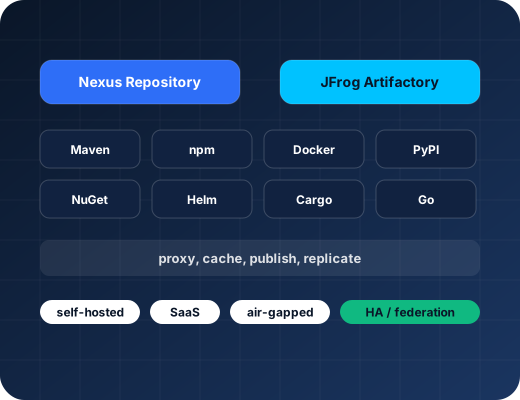
An artifact repository manager stores the binaries, packages and containers a build produces and consumes: Maven jars, npm packages, Docker images, Python wheels and, increasingly, AI/ML models. It sits between developers and public package registries, caching dependencies, controlling who can publish and pull, and giving a team one place to look when a build breaks or a component needs to be traced. Two vendors dominate the shortlist for this role: Sonatype, with Sonatype Nexus Repository, and JFrog, with JFrog Artifactory.
Sonatype describes Sonatype Nexus Repository as a tool used to "manage binaries, containers, AI models, and build artifacts in a single, centralized artifact repository tool," available in a free Community Edition and a paid Professional edition. JFrog describes JFrog Artifactory as "a universal artifact management platform that serves as the system of record for everything in your software supply chain," offered as free non-commercial editions alongside commercial Pro X, Enterprise X and Enterprise+ tiers.
Both are tools SecOpsTool supplies, so this comparison sets out what each vendor's own documentation says about editions, supported formats, high availability, multi-site replication, security-scanning relationships and deployment options. It does not pick a winner: the right choice depends on which package ecosystems your teams use today, how many sites need to stay in sync, and whether vulnerability scanning needs to live inside the same purchase or can be a separate product.
Editions: free downloads and paid tiers
Sonatype names two editions for Sonatype Nexus Repository. Sonatype's own documentation states that "Sonatype Nexus Repository comes in Professional and Community Editions." Community Edition is a free, self-hosted download, and Sonatype states it "supports up to 40,000 total components and 100,000 requests per day." When a deployment goes over either number, Sonatype's limitation notice explains that "Community Edition's built-in safeguards will pause the addition of new components until usage returns below both thresholds."
JFrog structures editions differently. Its Feature Comparison Matrix names three non-commercial, free licenses - JFrog Container Registry (JCR), JFrog Artifactory Open Source (OSS), and JFrog Artifactory Community Edition for C/C++ (CE C/C++) - alongside three commercial tiers: Pro X, Enterprise X and Enterprise+. Unlike Sonatype's Community Edition, JFrog's matrix does not state a numeric component or request-per-day cap for its free editions; the difference between JFrog's free and paid tiers is expressed mainly in which package types, replication and security features are included, covered below.
Sonatype's Community Edition limit is a usage ceiling that pauses new components once a deployment crosses it. JFrog's free editions are instead scoped by package type: Artifactory OSS supports only Maven, Gradle, Ivy, SBT and Generic repositories, and the Community Edition for C/C++ supports only Conan and Generic repositories, per JFrog's own matrix.
Supported package and artifact formats
Sonatype states that "Sonatype Nexus Repository supports 20+ formats and integrates with your favorite tools." Its Self-Hosted Nexus Repository Feature Matrix lists the same format set for both Community and Professional editions: Alpine, Ansible, APT, CocoaPods, Conan, Conda, Docker, Git LFS, Go Modules, Gradle, Helm, Maven, npm, NuGet, OCI, p2, Pub, PyPI, R, Rust Cargo, RubyGems, Swift, Terraform and Yum. Sonatype's Community Edition onboarding page adds that the free edition also carries "previously Pro-only formats, including Composer (PHP), Rust/Cargo, Conan v2, as well as compatibility with future innovations like AI/ML-focused formats such as Hugging Face."
JFrog's Artifactory product page states "60+ artifact types: packages, files, and AI assets," and its Supported Package Types documentation says "the JFrog Platform supports the following package managers, clients, and tools, with new formats added regularly." That page names dozens of formats, including Maven, npm, PyPI, NuGet, Docker, Helm, Terraform, Conan, Cargo, RubyGems, Debian, RPM and Hugging Face. Format support is not identical across JFrog's own editions: the Feature Comparison Matrix shows JCR limited to Docker, Helm, OCI and Generic repositories; OSS limited to Maven, Gradle, Ivy, SBT and Generic; and Community Edition for C/C++ limited to Conan and Generic. "All package types" becomes available starting at Pro X.
Get a 14-day free trial with expert onboarding from SecOpsTool, or compare it with the alternatives first.
High availability
High availability works differently on each product. Sonatype's High Availability Deployment documentation opens with "Only available in Sonatype Nexus Repository Pro," and describes the architecture as "a cluster of redundant instances, or nodes, running simultaneously within a single data center" behind an application load balancer, connected to a shared external PostgreSQL database and shared blob storage. Sonatype states "a minimum of two nodes are required for HA deployments."
JFrog's Feature Comparison Matrix places its equivalent rows - "High availability (five-nines uptime, redundant cluster, unlimited scalability)," "Maximized uptime (up to 99.999%)" and "Load balancing" - starting at the Enterprise X edition, not at Pro X. The same matrix shows "Artifactory servers" scaling from 1 (non-commercial and Pro X) to 3 (Enterprise X) to 6 (Enterprise+).
Multi-site replication and federation
Sonatype's Pro-only Content Replication feature moves content using a proxy pre-fetch model: "Publish artifacts to one Nexus Repository instance and have other instances pre-fetch them through a standard proxy repository." Sonatype documents this as useful to update "multiple distribution services all proxying the primary development source" or set up "bi-directional replication of content between two development teams," configured repository by repository.
JFrog's equivalent, Federated repositories, works as peer-to-peer synchronisation rather than a proxy relationship. JFrog's documentation defines it as "a repository type in JFrog Artifactory that enables multi-site artifact management across geographically distributed JFrog Platform Deployments (JPDs)," and states that "a Federation is a collection of Federated repositories in up to 10 JPDs at different sites that are automatically configured for full bi-directional replication." Federated repositories "support all Artifactory package types except TerraformBackend." Per the Feature Comparison Matrix, Federated repositories are "Not included" for non-commercial and Pro X editions and become available from Enterprise X.
Vulnerability and malware scanning: a separate purchase either way
Neither product bundles its own scanning engine into the base repository manager; both vendors sell it as a related, separately positioned product.
Sonatype's scanning product is Sonatype Repository Firewall, described on its own product page as "Designed for Sonatype Nexus Repository," with the same page stating that "when paired with Sonatype Repository Firewall, malware is blocked before it disrupts builds." For teams that do not run Nexus Repository, Sonatype separately offers Firewall Pro, which the page describes as "built for repositories other than Nexus Repository," inviting teams that want "malicious protection without moving to Sonatype Nexus Repository" to "take advantage of Sonatype Firewall Pro." Sonatype also sells Sonatype Lifecycle, its software composition analysis product for open-source vulnerability and licence policy; per Sonatype's own pricing page, new customers now purchase this capability as part of a bundle Sonatype calls Sonatype Guide.
JFrog's equivalent is JFrog Xray, described on its own product page as "an enterprise grade software composition analysis (SCA) tool that provides organizations with a simple way to identify, prioritize and remediate security vulnerabilities and license compliance issues in open source software (OSS) and third party components." JFrog's Feature Comparison Matrix shows Xray as "Not included" for the non-commercial editions and "Included" starting at Pro X, with a separate "Xray HA" row that is not included until Enterprise X and becomes "Built-in" at Enterprise+.
Deployment options
Sonatype states that Sonatype Nexus Repository is "available as a SaaS offering, as a self-hosted version for data centers and cloud deployments, and a fully disconnected version for air-gapped environments," and separately describes the SaaS option as "now available as a fully managed, cloud-hosted service, eliminating the overhead of infrastructure management."
JFrog states that JFrog Artifactory offers "Fully managed SaaS, self-managed, multi-cloud, and hybrid support," with SaaS available, per its Feature Comparison Matrix, across the same Pro X, Enterprise X and Enterprise+ naming used for self-managed licensing.
Nexus Repository vs JFrog Artifactory at a glance
The table below summarises the points checked against each vendor's own documentation. A source note for every row is recorded in SecOpsTool's research notes for this comparison.
| Comparison point | Sonatype Nexus Repository | JFrog Artifactory |
|---|---|---|
| Free / non-commercial edition | Community Edition (self-hosted, free) | JFrog Container Registry, Artifactory OSS, Community Edition for C/C++ (each free, self-hosted) |
| Paid editions | Professional (Pro), cloud or self-hosted | Pro X, Enterprise X, Enterprise+ |
| Format count (vendor figure) | 20+ formats | 60+ artifact types |
| Format scope on the free edition | Same format list as Pro | Narrower per free edition (for example, OSS covers only Maven, Gradle, Ivy, SBT, Generic) |
| Community/free usage limit | 40,000 components and 100,000 requests per day, then new components pause | No numeric component or request cap stated on the matrix checked |
| High availability | Pro only; minimum two nodes behind a load balancer | Included from Enterprise X; scales from 1 to 3 to 6 Artifactory servers by edition |
| Multi-site sync | Content Replication (Pro): one-way proxy pre-fetch, repository by repository | Federated repositories (Enterprise X and up): peer-to-peer bidirectional sync, up to 10 sites per federation |
| Vulnerability / malware scanning | Separate product: Sonatype Repository Firewall (plus Firewall Pro for non-Nexus repositories) | Separate product: JFrog Xray, included from Pro X upward |
| Deployment options | SaaS, self-hosted, fully disconnected / air-gapped | Fully managed SaaS, self-managed, multi-cloud, hybrid |
How to choose
Neither vendor's documentation supports declaring one product better than the other; the two are built around different defaults, and the right one depends on what a specific team already runs. A few questions worth answering from the vendor documentation above before shortlisting either tool:
- Which package ecosystems does your build pipeline actually use today, and does the free edition of either product cover all of them, or does covering them mean moving to a paid tier?
- Does your current or planned usage sit comfortably under Sonatype's Community Edition thresholds of 40,000 components and 100,000 requests a day, or would you already need Pro?
- How many physical or cloud sites need to stay synchronised, and does your team need one-way proxy replication or full bidirectional federation across sites?
- Do you want vulnerability and malware scanning bundled into the same purchase decision as the repository manager, or run as a clearly separate product and budget line?
- Which deployment model does your security policy require: SaaS, self-managed, or a fully disconnected air-gapped install?
Once those answers are clear, the next step is a technical evaluation of both products against your own repositories and CI/CD pipeline, rather than relying on either vendor's marketing page alone. SecOpsTool supplies both JFrog Artifactory and Sonatype Nexus Repository in India and can arrange a scoping call to map your package ecosystems, site count and security requirements against each vendor's editions before you commit to one.
Questions Buyers Ask
Yes. Sonatype publishes a free, self-hosted Community Edition, which Sonatype states supports up to 40,000 total components and 100,000 requests per day. A paid Professional edition removes those limits and adds features such as high availability, SAML and Content Replication.
Yes. JFrog's Feature Comparison Matrix lists three free, self-hosted non-commercial licenses: JFrog Container Registry, Artifactory OSS (Java-focused) and Community Edition for C/C++ (Conan-focused). Paid Pro X, Enterprise X and Enterprise+ editions add Xray scanning, high availability and federation.
Both are separate, additional products rather than built-in features of the base repository manager. Sonatype positions Repository Firewall as designed for Nexus Repository, with a Firewall Pro variant for other repositories. JFrog includes Xray, its SCA tool, starting from the Pro X edition of Artifactory.
Sources
Primary documents this article is based on. Regulatory clauses and product statements above are taken from these pages.
- Sonatype Nexus Repository product page
- Sonatype Nexus Repository docs hub
- Nexus Repository Community Edition Onboarding
- Self-Hosted Nexus Repository Feature Matrix
- Nexus Repository High Availability Deployment
- Nexus Repository Content Replication
- Sonatype Repository Firewall product page
- JFrog Artifactory product page
- JFrog Feature Comparison Matrix
- JFrog Supported Package Types
- JFrog Federated Repositories concept doc
- JFrog Xray product page