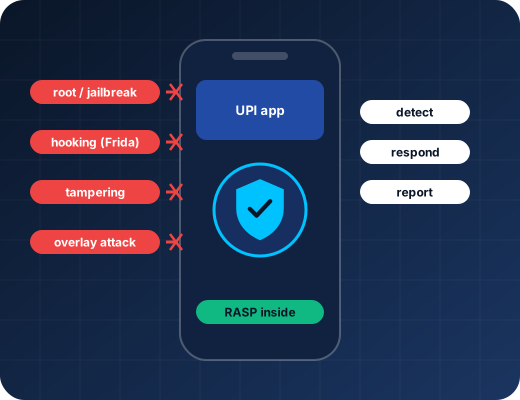
Most mobile apps that handle payments or personal financial data ship with no defence against runtime attacks. The OWASP Mobile Application Security project catalogues these runtime weaknesses under its MASVS-RESILIENCE category, covering root and jailbreak detection, dynamic instrumentation tooling, debugger detection and app integrity verification - controls that pre-release SAST and DAST testing do not exercise.
The Mobile Threat Landscape That Static Testing Misses
Most mobile app security programmes focus on pre-release testing - SAST scanning the APK, DAST testing the backend APIs, manual penetration testing before release. This is necessary and valuable. But it completely ignores what happens after your app is installed on a user's device.
Runtime threats that static testing cannot detect: Root/jailbreak exploitation, dynamic instrumentation frameworks (Frida, Xposed), screen capture and keyloggers, SSL/TLS interception (MITM), app repackaging and redistribution, debugger attachment, emulator-based automation attacks.
How Runtime Attacks Work Against Fintech Apps
Understanding the attack patterns helps explain why runtime protection matters:
Frida-Based Hook Injection
Frida is a dynamic instrumentation framework widely used by security researchers - and attackers. On a rooted Android device or jailbroken iPhone, Frida can inject JavaScript into a running application, hooking any function to intercept data. A financial app's payment processing function, authentication logic, or cryptographic key handling can all be observed and manipulated in real time. No vulnerability in your code required - just runtime access.
App Repackaging
Attackers decompile your APK, inject malicious code (keyloggers, screen scrapers, C2 backdoors), repackage it, and distribute it through alternative app stores or phishing links. Users believe they're running your legitimate app. Without anti-tamper runtime checks, your app has no way to know it's been compromised.
MITM on Unprotected SSL
Apps that don't implement SSL certificate pinning are vulnerable to man-in-the-middle attacks using proxy tools like Charles or Burp Suite. On a compromised network, an attacker intercepts all API traffic - capturing transaction data, session tokens, and authentication credentials without any server-side indication of compromise.
// App: PaymentApp v2.3.1 | Device: Android 13
[CRITICAL] ROOT_DETECTION: Device is rooted (Magisk v26.1)
[CRITICAL] HOOK_DETECTION: Frida server detected on port 27042
[HIGH] INTEGRITY_CHECK: APK signature mismatch - repackaged app
[HIGH] SSL_PINNING: Certificate mismatch - MITM proxy detected
[MEDIUM] EMULATOR: Running in Android emulator (Genymotion)
Action taken: Session terminated, user notified
Telemetry sent to security dashboard: YES
Get a 14-day free trial with expert onboarding from SecOpsTool, or compare it with the alternatives first.
How Bugsmirror Works: In-App Intelligence
Bugsmirror is a lightweight SDK that is embedded into your Android or iOS application during the build process. Unlike network-based solutions (WAF, API gateways), Bugsmirror operates entirely within the application itself - meaning it works regardless of network conditions and cannot be bypassed by routing traffic differently.
Key Detection Capabilities
- Root and Jailbreak Detection: Multi-layer root/jailbreak detection that identifies Magisk and other popular rooting and jailbreaking tools - including techniques to detect when root is hidden
- Dynamic Instrumentation Detection: Detects Frida, Xposed and LSPosed, and other hooking frameworks - blocking function interception before it can capture sensitive data
- Anti-Tampering: Continuously verifies the integrity of the app binary against the original signed APK/IPA - terminating sessions if tampering is detected
- SSL Certificate Pinning: Enforces that API communications only accept your genuine certificates - blocking all proxy-based MITM attacks
- Screen Capture and Keylogger Protection: Prevents screen reading tools from capturing OTP screens, PIN entry, and transaction details
RBI Compliance: Why This Matters for Indian Fintech
RBI's Master Direction on Digital Payment Security Controls applies to Scheduled Commercial Banks (excluding Regional Rural Banks), Small Finance Banks, Payments Banks and credit card issuing NBFCs. It states that regulated entities "may explore the feasibility of implementing a code that checks if the device is rooted/ jailbroken prior to the installation of the mobile application and disallow the mobile application to install/ function if the phone is rooted/ jailbroken" (clause 58), and that on detecting anomalies the app was not programmed for, the customer should be directed to reinstall a fresh copy of the application (clause 55). Bugsmirror's root and jailbreak detection and app integrity verification support these controls.
🔒 Try Bugsmirror Free for 14 Days
Integrate Bugsmirror into your Android or iOS app and see exactly what runtime threats your users are facing - in real time. Full-featured trial with our mobile security engineers on call.
Start My Free 14-Day Bugsmirror Trial →The Integration Question: How Hard Is It?
One of the most common objections to mobile RASP adoption is integration complexity. Bugsmirror addresses this with what the vendor describes as zero-code integration, requiring no changes to the application's own source code. Supported platforms include native Android and iOS as well as cross-platform frameworks such as React Native, Flutter, Kotlin, Xamarin and Ionic, so cross-platform apps don't require separate integration work.
The question is no longer whether your mobile app faces runtime attacks - it does, every day, in your users' hands. The question is whether your app will detect and respond to those attacks, or remain silently compromised while attackers harvest your users' financial data.
RASP is not a luxury for fintech apps. It's table stakes for any application that handles payments, authentication, or personal financial data in India's threat environment.
Sources
Primary documents this article is based on. Product statements and regulatory clauses above were checked against these pages.
- OWASP MASVS-RESILIENCE
- Frida - dynamic instrumentation toolkit
- Bugsmirror
- Bugsmirror Defender (RASP) product page
- Bugsmirror Knowledge Base
- RBI Master Direction on Digital Payment Security Controls
- CERT-In Guidelines index