Dynamic Application Security Testing (DAST) is an established testing category. OWASP's Developer Guide describes it as "a non-functional testing process to identify security weaknesses and vulnerabilities in applications" that works as a black-box test against a running application, without access to source code. That definition has not changed. What has changed is how many DAST vendors now put the word "AI" in front of it.
Several DAST vendors have added AI-branded features to their scanners: smarter crawling, automatic handling of login forms, autonomous exploit chains, one-click proof of exploitation, and in-tool assistants that help a human tester work faster. Some of this is documented product behaviour you can read in the vendor's technical documentation. Some of it is a headline figure from the vendor's own testing. And parts of any DAST engagement, such as scoping, authorisation, and judging whether a finding is a real business risk, stay a human's job regardless of how much AI sits inside the scanner.
This article separates the three. It starts with what OWASP says conventional DAST does, then goes through what four vendors, Bright Security, Sec1, Acunetix (now marketed as Invicti Web + API) and Burp Suite, document about their own AI features, quoting only their own sites and documentation.
What conventional DAST tests, and how
OWASP's Developer Guide describes DAST as testing that "can be carried out manually or be automated" and works because the tool does "not have access to the source code and therefore detect[s] vulnerabilities by actually performing attacks" against a running application. OWASP's page on vulnerability scanning tools describes the same category from the tool's side: "Web Application Vulnerability Scanners are automated tools that scan web applications, normally from the outside, to look for security vulnerabilities such as Cross-site scripting, SQL Injection, Command Injection, Path Traversal and insecure server configuration."
OWASP states the category's advantage and its limitation together. The advantage: "The big advantage of these types of tools are that they can scan year-round to be constantly searching for vulnerabilities." The limitation: "Because these tools does dynamic testing, it cannot cover 100% of the source code of the application." What fills that gap is stated just as directly: "Manual assessment of an application involves human intervention to identify security flaws which might slip from an automated tool."
OWASP also notes DAST is a crowded category: "A large number of both commercial and open source tools of this type are available and all of these tools have their own strengths and weaknesses." That is the backdrop for "AI DAST" marketing.
Why "AI DAST" has become a vendor category
Neither OWASP page above uses the term "AI DAST", and no equivalent term was found on any other OWASP page checked for this article. It is a vendor marketing label, not a standards body's testing category, and it should be read that way: as a claim to check against a specific vendor's documentation.
Reading what the four vendors covered here document, their AI features fall into three recurring patterns:
- Coverage and crawling: helping the scanner reach more of the application, for example by filling in forms, predicting endpoints, or getting past a login screen.
- Exploitation and validation: chaining requests into a working exploit, generating evidence of impact, and filtering out findings that do not exploit.
- An assistant inside a manual testing tool: summarising a request or suggesting the next test, while a human tester decides what to do with it.
Get a 14-day free trial with expert onboarding from SecOpsTool, or compare it with the alternatives first.
Bright Security: runtime validation, an autofix agent, and MCP scanning
Bright Security describes its core product as follows: "Bright is a powerful dynamic application & API security testing (DAST) platform." The wider platform, Bright STAR, is described as "an AI-powered AppSec platform that finds, fixes, and validates real vulnerabilities early in the SDLC." The homepage frames this as runtime validation: "Continuously Validate Applications, APIs, And AI-Generated Code To Reduce Real Security Risk."
Bright publishes a specific workflow for its GitHub remediation agent. It "Connects to Bright through MCP using GitHub-issued OIDC identity" and "Detects the runnable application and starts it inside the GitHub environment" before scanning. In remediation mode it "applies fixes, restarts the app, and validates the result", and "at the end of the session, the agent provides a report about vulnerabilities it found and how they were addressed and code changes that address found vulnerabilities."
Bright also documents testing of MCP servers used by AI agents: "When Bright discovers an MCP server, it automatically: 1. Identifies the MCP server 2. Extracts its tools, resources, and prompts 3. Creates a separate entry point for each item", over "HTTP Streaming" using a named MCP protocol revision. Each tool, resource and prompt an MCP server exposes becomes its own testable entry point.
Bright keeps false positives below 3 percent through that runtime validation, and automates up to 98 percent of remediation with verified fixes. Both figures come from Bright's own testing, which is why we recommend running a trial on your own applications to see how they hold up for you.
Sec1 DAST (Kairo): agent swarms and a proof-of-exploit engine
Sec1 runs two live product pages for what appears to be the same dynamic testing capability, one branded "Kairo" and one branded "Sec1 DAST" (also labelled "AI DAST" in the site's main navigation). Both names are used here because the vendor has not consolidated them.
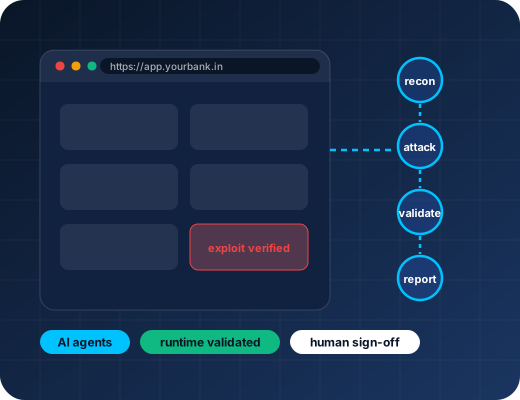
Sec1 DAST runs on "12 Agent Swarms. 26 AI Agents", defined as "self-orchestrating AI agents that autonomously crawl, reason, attack, validate & report." It runs 280+ checks across categories it lists as injection attacks, cross-site scripting, authentication flaws, misconfigurations, CSRF, SSRF, RCE, file inclusion, path traversal, business logic, API security, data exposure, and SSL/TLS and network issues.
Sec1 also documents a four-step Proof-of-Exploit Engine: "Vulnerability Detected" (AI identifies a potential vulnerability through contextual analysis), "Exploit Crafted" (a context-aware payload is generated and safely executed in a sandbox), "Evidence Captured" (full HTTP traces, extracted data and an impact assessment are documented), and "Attack Replayed" (a one-click replay lets developers reproduce and verify the fix).
The same product page lists a compliance-mapping feature naming specific clauses: "PCI-DSS - Sections 6.6, 11.3", "NIST 800-53 - SI-10, CA-7, RA-5", and "OWASP Top 10 - Full Coverage". This is Sec1's own mapping of its findings to those references rather than an external certification, so agree its scope with Sec1 during the evaluation. The page also states the product bundle includes SCA and SAST alongside DAST.
Acunetix (Invicti Web + API) and Burp Suite: AI added to established scanners
Acunetix's own homepage now states "Acunetix is now Invicti Web + API", with technical documentation at docs.invicti.com. The Acunetix marketing page lists three AI-branded features: "AI-driven risk scoring" predicting "risk using 200+ signals before scanning"; "Multi-agent attack simulation: Coordinate specialized AI agents that work in parallel to execute real-world attack strategies"; and "AI-powered remediation: Deliver fix guidance tailored to your developers."
Invicti's own docs describe a related feature, Predictive Risk Scoring, which "helps you prioritize your web assets before scanning them" using AI scores calculated with "a minimum 83% confidence level" from "up to 220 data points, such as deprecated TLS versions, website age, and insecure cookies." The docs also describe Enhanced Crawl Coverage ("AI Form Interaction", "AI Path Prediction", "AI User Flow Detection") and AI-Aided Auto-Login, which adds "AI recovery for failed LSR playback" so a scan can "continue without manual intervention" if a recorded login breaks. On data use: "We don't use your data to train AI models." Notably, Invicti's signature exploit-confirmation method, proof-based scanning, is documented in non-AI terms: it "safely exploits confirmed vulnerabilities in a read-only manner and generates a concrete proof-of-exploit." The AI features sit on top of that existing engine.
PortSwigger documents two separate AI capabilities in Burp Suite Professional. Burp AI is an assistant invoked inside existing tools: Explore Issue "follows up on issues like a human pentester would, attempting exploits, identifying additional attack vectors"; Explainer lets a user highlight part of a message to "get an AI-generated explanation"; a Broken Access Control feature "intelligently filters out false positives before they're reported"; and AI-powered recorded logins "generate recorded login sequences automatically, saving time and eliminating the possibility of human error." PortSwigger states "none of them run unless you explicitly activate them", and that "AI augments your expertise but never replaces it: you stay in control, driving the test."
Burp AT is a separate, more autonomous capability, described as "Agentic AI that extends human-led pentesting", where agents "operate reliably within the scope and permission boundaries you define." PortSwigger states that "scope, tool access and approval rules live in Burp's tooling layer, architecturally separate from the model."
Documented capability, published figure, or human task
Reading across all four vendors, it helps to sort what they publish into three buckets: a described behaviour you can verify in the documentation, a headline figure from the vendor's own testing, and a task that stays with a person no matter which scanner is running.
| Area | Documented capability | Published figure | Still a human task |
|---|---|---|---|
| Crawling and login handling | Invicti's AI Form Interaction, AI Path Prediction, AI User Flow Detection and AI-Aided Auto-Login are named, documented features | The 83% confidence figure and 220 data points behind Predictive Risk Scoring | Confirming the crawler reached the application's business-critical workflows |
| Exploit validation | Sec1's four-step Proof-of-Exploit flow and Invicti's proof-based scanning both produce replayable evidence, not just a flagged pattern | Sec1's agent-count and coverage figures beyond the statically published "280+ Checks" | Deciding whether a technically valid finding is a real business risk |
| Remediation | Bright's GitHub Agent workflow (detect, run, scan, fix, restart, re-check, report) is documented step by step | Bright's "up to 98% automated remediation" and "less than 3% false positives" figures | Reviewing and merging any AI-suggested code fix before it ships |
| In-tool assistance | Burp AI's Explore Issue, Explainer and false-positive filtering features are documented and require explicit activation | N/A, Burp AI's features are described qualitatively, not with a published accuracy statistic | Setting the scope and permission boundaries Burp AT operates within |
| Scope and authorisation | Not an AI feature of any product | N/A | Every vendor above still requires a target to be defined, access authorised, and a person to interpret the report |
This is consistent with what OWASP says about DAST generally: automation can run constantly and cover a lot of ground, but it "cannot cover 100% of the source code of the application", and manual review still catches "security flaws which might slip from an automated tool." Adding AI changes what the automated part can reach and how quickly it produces evidence; it does not remove the manual part.
Evaluating an AI DAST claim before you buy
A few practical questions, grounded in what these vendors actually publish, help separate a documented feature from a marketing line during an evaluation:
- Ask for the specific documentation page behind any AI feature, not just the homepage stat. Bright, Sec1, Invicti and PortSwigger each publish technical docs for their AI features.
- Ask whether the AI feature runs by default or has to be switched on. Burp AI requires explicit activation per feature; check whether the tool you are evaluating gives you the same control.
- Ask what evidence a finding produces. A proof-of-exploit or proof-based-scanning result that replays the attack is easier to act on than a flagged pattern with no reproduction steps.
- Ask how a vendor's compliance mapping, such as Sec1's PCI-DSS and NIST 800-53 clause references, was derived, and confirm its scope before relying on it in an audit.
- Keep scoping, authorisation and business-logic review as your own team's responsibility. None of the four vendors covered here claim to remove that step.
If you are evaluating Sec1 DAST, Bright Security, Acunetix (Invicti Web + API) or Burp Suite for your own application portfolio, SecOpsTool can arrange a scoping call to match each tool's documented capabilities and deployment options to your environment before you commit to a trial.
Questions Buyers Ask
No vendor covered here documents that. PortSwigger states of Burp AI that "AI augments your expertise but never replaces it: you stay in control, driving the test", and even the more autonomous Burp AT operates "within the scope and permission boundaries you define". Scoping, authorisation and business-logic judgement remain manual steps across all four vendors reviewed.
Based on vendor documentation, the additions cluster into three areas: reaching more of the application during crawling and login (Invicti's AI Form Interaction, AI Path Prediction and AI-Aided Auto-Login), producing validated exploit evidence faster (Sec1's Proof-of-Exploit Engine, Bright's runtime validation), and assisting a human tester inside the tool itself (Burp AI's Explore Issue and Explainer features).
Bright reports fewer than 3 percent false positives and up to 98 percent automated remediation; Invicti's Predictive Risk Scoring works at a minimum 83 percent confidence level; Sec1 runs 280+ checks with a proof-of-exploit replay for each finding. Each figure comes from that vendor's own testing, so the best check is a trial on your own application, which SecOpsTool can arrange.
Sources
Primary documents this article is based on. Regulatory clauses and product statements above are taken from these pages.
- OWASP Developer Guide - DAST
- OWASP - Vulnerability Scanning Tools
- Bright Security docs - Introducing Bright
- Bright Security - homepage
- Bright Security docs - GitHub Agent
- Bright Security docs - MCP entry points
- Sec1 - DAST (Kairo) product page
- Acunetix (Invicti Web + API) homepage
- Invicti docs - Enable AI features
- Invicti docs - AI-enhanced coverage and crawling
- PortSwigger docs - AI features (Burp AI)
- PortSwigger - Burp AT