OWASP defines dynamic application security testing (DAST) as a non-functional testing process that identifies security weaknesses in a running application. A DAST tool communicates with the application through its front end, the way an attacker would, without needing access to source code, and OWASP is explicit that this black-box approach cannot cover 100 percent of an application's source code or attack surface. That single limitation is why buying a DAST tool really means buying two things: a testing engine, and everything a vendor has built around it to make that engine's coverage, accuracy and reporting good enough to trust.
OWASP also publishes the closest thing to an independent syllabus for what a serious DAST product should be capable of. The OWASP Web Security Testing Guide (WSTG) lays out twelve test categories, from authentication and session management through to API testing, and the OWASP API Security Top 10 lists ten specific risk categories that any tool claiming API coverage should be able to speak to. Vendor documentation is the other primary source: what a product actually does with authentication, APIs, single-page applications, CI/CD pipelines and compliance reporting is defined by the vendor, not by a review site.
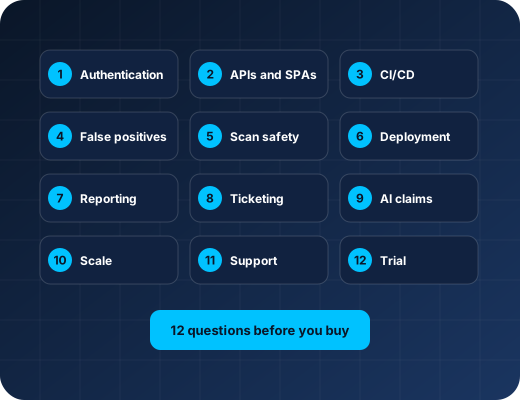
The 12 questions below are built from those two sources: OWASP's own guidance on what needs testing, and the published documentation of DAST tools SecOpsTool supplies, including Bright Security, Burp Suite, Acunetix (now marketed as Invicti Web + API), Sec1 DAST, HCL AppScan and Levo.ai. Use them to compare vendors on what their products actually do rather than on marketing language alone.
Testing coverage: does it reach your real attack surface
1. How does it handle your authentication flows?
Most of an application sits behind a login. OWASP's Web Security Testing Guide gives authentication its own dedicated test category, one of twelve, precisely because a scan that cannot log in only reaches the pages anyone can see anonymously. Ask a vendor exactly how their tool logs in: does it detect a standard login form automatically, does it need a recorded sequence for anything more complex, and what happens when a session expires mid-scan or the application asks for a one-time password?
HCL AppScan's documentation describes this mechanic directly: when you record a login, "AppScan will extract the relevant parameters from the traffic and add them to the OTP HTTP-parameters list," though OTP only works with its Action-based login playback method, not Request-based login. Acunetix documents its Login Sequence Recorder for applications its automatic detection cannot handle: "you might need to launch the Acunetix Login Sequence Recorder (LSR) and record a login sequence." Bright Security's documentation names browser-based form login (recorded and manual multi-step), header authentication, OIDC/OAuth, custom API multi-step authentication, NTLM and OTP entry as supported methods.
2. Does it test your APIs, not just your web pages?
A web application today is usually a front end calling a set of APIs, and OWASP maintains a separate API Security Top 10, ten categories running from Broken Object Level Authorization to Unsafe Consumption of APIs, because API vulnerabilities do not map cleanly onto the OWASP Top 10 written for web pages. Ask which API description formats a tool actually imports, and whether its tests are organised against the API Security Top 10 categories.
Bright Security's documentation states it "Scans any target, whether Web Apps, APIs (REST & SOAP, GraphQL & more) or mobile," and supports Swagger 2+, OpenAPI 3+ and Postman 2+ schema formats. Burp Suite DAST ingests "Postman Collections, OpenAPI, SOAP, and GraphQL." Levo.ai states its coverage spans "REST, GraphQL, gRPC, and SOAP APIs" and documents a dedicated page for each OWASP API Security Top 10 category.
Coverage for modern front ends and delivery pipelines
3. Can it crawl a single-page application?
A crawler that only follows plain HTML links will miss most of a React, Angular or Vue application, because the routes and forms are generated by JavaScript at runtime rather than written into the page source. Ask whether a vendor's crawler actually executes JavaScript like a browser, or whether it needs a recorded traffic file to reach client-side routes.
Acunetix documents its DeepScan crawler as "a DOM parser based on an improved Chromium engine" that "crawls HTML5 websites including single-page applications (SPA) and executes JavaScript just like a real browser would," and states it can specifically discover "Angular, Vue, and React."
4. Does it run inside your CI/CD pipeline, not just on demand?
A DAST scan that only ever runs manually will not catch a regression introduced between releases. Look for a native plugin or action for the CI system you already use, plus a CLI or API so scans can be scripted and gated on a build.
Burp Suite DAST publishes dedicated setup guides for Jenkins, GitHub Actions, GitLab, Azure DevOps and TeamCity. Bright Security documents integrations with GitHub Actions, CircleCI, Jenkins, Azure Pipelines, Travis CI, JFrog, GitLab and TeamCity, alongside a CLI and REST API for scripting scans directly. Sec1 DAST lists CI/CD integrations with Jenkins, Azure DevOps, CircleCI, AWS CodePipeline and GitHub Actions.
Get a 14-day free trial with expert onboarding from SecOpsTool, or compare it with the alternatives first.
Trusting, and safely producing, the results
5. How does it cut down false positives?
A scanner that floods a team with unconfirmed findings gets ignored. Ask a vendor to explain, specifically, how a finding gets confirmed before it is reported, not only the headline accuracy figure.
Bright Security keeps false positives under 3% by validating every result through runtime testing. Acunetix reaches 99.98% confirmation accuracy for exploitable vulnerabilities, backed by proof-of-exploit evidence. Sec1 uses a four-step proof-of-exploit flow: a vulnerability is detected, an exploit is crafted and run in a sandbox, evidence such as HTTP traces is captured, and the attack is replayed so a developer can verify a fix. HCL AppScan documents "AI-driven Scan Accuracy with IFA 2.0" for its static analysis (SAST) results, which it states "filters out up to 98% of false positives and groups related issues into single fix points"; ask how the same validation applies to its DAST findings.
6. How does it control scan scope so it does not break production?
Some active security checks are, by design, capable of damaging data or taking a system down, so scope and intrusiveness controls matter as much as detection quality. Ask whether checks are grouped by risk level, whether paths can be excluded, and whether the vendor's own documentation warns you before an aggressive scan is run against a live system.
Burp Scanner's documentation separates checks into passive, light active, medium active and intrusive active tiers, and states plainly: "Use extreme caution if you choose to run intrusive active scan checks on live systems. They may cause permanent data loss, service outages, or other irreversible impacts." It also documents exclude paths, which "define the URLs that Burp Scanner is not allowed to crawl or audit."
Deployment fit and audit-ready reporting
7. On-premises, SaaS, or both?
The right deployment model depends on where the application actually sits: an internet-facing SaaS product can usually be scanned from the vendor's cloud, but an internal system behind a firewall needs an on-premises or agent-based option.
Bright Security documents three options: a multi-tenant SaaS service, a separate Bright-managed Private Cloud, and an on-premises Repeater for targets that cannot be reached directly from the internet, all currently hosted on AWS. Burp Suite DAST can be deployed "on-premise ... with an interactive installer, a Kubernetes deployment, or a cloud-based instance." HCL AppScan documents deployment as "cloud, on-premises, sovereign cloud, air-gapped, and hybrid." Acunetix's current Web + API pricing page lists "Cloud Hosting" with "On-Premises (coming soon)," meaning an on-premises option for that specific product is not yet available.
8. Does its reporting map to the frameworks your auditors ask for?
A generic compliance-ready claim is not the same as a named, pre-built report for the standard you are actually audited against. Ask for the exact list of report templates a tool ships with.
HCL AppScan documents report templates including the Payment Card Industry Data Security Standard, NIST Special Publication 800-53, GDPR, HIPAA, ISO 27001, ISO 27002, the CWE Top 25 Most Dangerous Software Weaknesses and DISA STIG. Acunetix's report list includes the same CWE Top 25 and DISA STIG templates, plus HIPAA, ISO 27001, the OWASP Top 10 and PCI standards. Burp Suite DAST is documented as checking for the PCI DSS standard and the OWASP Top 10.
Workflow integration and AI claims
9. Does it open tickets where your team already works?
A finding that has to be manually copied into a ticketing system is a finding that is more likely to be lost. Check which trackers a tool writes to directly, not just which ones it can export a report to.
Bright Security's Jira integration lets "tickets to be automatically opened for each security vulnerability detected," including severity, discovery details, possible exposure and remediation suggestions. Acunetix integrates with "Azure DevOps (Microsoft TFS), JIRA, GitHub, GitLab, Bugzilla, Mantis." HCL AppScan documents an Issue Management Gateway Service for Azure DevOps, Jira and RTC, alongside ServiceNow support.
10. What exactly does an AI-driven testing claim mean?
Several DAST vendors now describe their scanners as AI-driven, but the term covers different things: payload generation, triage of findings, remediation suggestions or risk scoring, and OWASP does not currently publish a benchmark specifically for AI-driven DAST claims. Ask a vendor to state, in writing, which steps their AI actually performs and what evidence backs any accuracy figure they quote.
Sec1 DAST is built on 12 agent swarms and 26 AI agents. Bright Security documents an AI Pentesting Module that "discovers your attack surface, builds a threat model, crafts real exploits, and validates every finding." Acunetix describes a Predictive Risk Scoring feature that uses a model analysing "over 200 features" to estimate risk level. HCL AppScan markets AI-driven scan accuracy for its SAST results, covered under question 5 above.
Fit for your organisation's scale and support
11. Does it scale to how many applications and how often you scan?
A tool that works well against one staging application in a proof of concept may behave differently across many production services scanned continuously. Ask for concurrency or throughput figures, and how the vendor prices and architects for that scale, rather than accepting an unqualified enterprise-grade description.
Sec1 DAST scans at 1000 URLs per minute with 50 or more parallel scans. Burp Suite DAST documents "Multi-user, role-based functionality for site hierarchy, scan detail and reporting," with single sign-on through "SAML or LDAP, as well as SCIM." Bright Security separates its multi-tenant SaaS architecture from a Private Cloud option described as "a completely separate, configurable cloud environment," aimed at larger or more isolated deployments.
12. What support do you actually get, and when?
"Support included" means little without hours and response times attached to it. Ask for those specifics in writing, and check whether a trial or evaluation period comes with hands-on help or is entirely self-service.
PortSwigger publishes exact support terms for Burp Suite: "Technical support is provided free of charge to all users via our Support Center," available "Monday to Friday between 9am and 5pm UK time," with "an initial response within one working day." HCL AppScan's own free trial is time-boxed and scan-limited: "This 14-day self-service free trial includes five free scans (DAST, SAST or SCA)."
What to do next
Take these 12 questions to a shortlist of two or three vendors and ask each one to answer them against their own current documentation, not a sales deck. Where a vendor makes a specific claim, such as a false-positive rate, a supported authentication method, or a compliance report template, ask for the page that states it.
Run a scoped evaluation against a real staging application before committing, covering at least one authenticated flow and one API, since that is where most DAST tools show the biggest differences. Bright Security is one of the tools SecOpsTool supplies that documents runtime-validated findings across web applications and APIs from a single platform, and is a reasonable starting point for that kind of evaluation. SecOpsTool can arrange a scoping call to match a shortlist of DAST tools to your applications and existing pipeline before you buy.
Questions Buyers Ask
OWASP describes DAST as a non-functional testing process that finds vulnerabilities in a running application from the outside, without access to source code, which OWASP calls a black-box test. This is commonly contrasted with SAST, which analyses an application's source code directly rather than testing it while running.
Not necessarily. Several DAST platforms document combined coverage: Bright Security states it scans web apps, REST and SOAP APIs and GraphQL from one platform, and Sec1 DAST and Levo.ai similarly document REST, GraphQL and SOAP coverage alongside web application testing.
No. OWASP defines DAST as a black-box test performed against the running application through its front end. Some vendors offer an optional grey-box addition, such as Acunetix's AcuSensor, which adds internal visibility without requiring source code changes, but this is a separate, optional component rather than a requirement of DAST itself.
Sources
Primary documents this article is based on. Regulatory clauses and product statements above are taken from these pages.
- OWASP Developer Guide: DAST
- OWASP WSTG v4.2 table of contents
- OWASP Top 10 (project page)
- OWASP API Security Top 10
- Burp Scanner: Auditing
- PortSwigger technical support
- Acunetix: DeepScan technology
- Acunetix: report types
- HCL AppScan: OTP/MFA handling
- Bright Security: introducing Bright
- Sec1 DAST product page
- Levo.ai: OWASP API Top 10 coverage