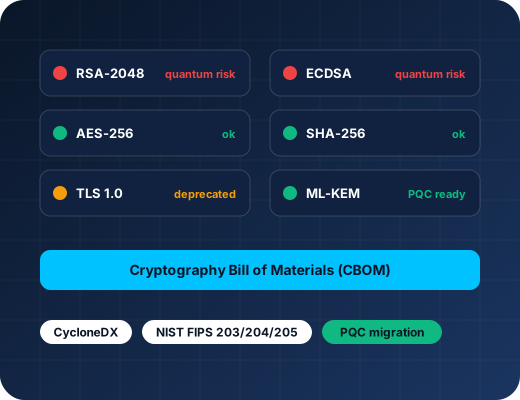
While most cybersecurity conversations in India's financial sector focus on Software Bill of Materials (SBOM), a newer and arguably more critical compliance requirement is emerging: the Cryptography Bill of Materials (CBOM). If SBOM tells regulators what open-source components you're running, CBOM tells them how you're protecting data - and whether your cryptographic posture will survive the next decade.
O3 Security markets its BOM platform to Indian regulated organisations, describing it as built for CERT-In, RBI and SEBI compliance, and made and hosted in India. Its CBOM pairs a cryptographic asset inventory with the encryption details that SEBI's CSCRF asks an SBOM to capture.
What is a Cryptography Bill of Materials (CBOM)?
A CBOM is a structured inventory of all cryptographic assets within your technology environment - every algorithm, key, certificate, cryptographic library, and protocol in use across applications, infrastructure, APIs, and databases. Just as an SBOM inventories software components, a CBOM inventories your cryptographic building blocks.
CBOM captures: cryptographic algorithms (symmetric and asymmetric), protocols, certificates and their expiry dates, keys, tokens and secrets - and flags which are quantum-vulnerable and which are quantum-safe. These are the asset categories CycloneDX documents for its Cryptography Bill of Materials.
Why SEBI and RBI Are Focused on Cryptographic Governance
SEBI's Cybersecurity and Cyber Resilience Framework (CSCRF), issued 20 August 2024, asks Regulated Entities to maintain an inventory of cryptographic assets and prioritise critical assets for Post-Quantum Cryptography (PQC) migration, as one of the indicative measures under its risk-assessment standard. Three driving forces make that inventory work urgent for Indian financial institutions today:
1. Quantum Computing Threat to Current Cryptography
RSA, ECC, and Diffie-Hellman - the algorithms protecting virtually every financial transaction today - are mathematically vulnerable to quantum computers running Shor's Algorithm. Cyber threat actors could already be targeting data that needs long-term protection, using a harvest now, decrypt later strategy, according to a joint factsheet from the US Cybersecurity and Infrastructure Security Agency, the NSA and NIST. NIST finalised its first post-quantum cryptography standards in 2024. Financial institutions that don't know which systems rely on quantum-vulnerable algorithms cannot plan their migration.
2. Cryptographic Debt in Legacy Financial Systems
Financial services run a mix of modern cloud-native applications and long-lived legacy systems. NIST's guidance on transitioning cryptographic algorithms deprecates SHA-1 through 2030, disallows 3DES key wrapping and RSA key transport with 1024-bit keys, and calls for TLS 1.0 and 1.1 to be disabled. Without a CBOM, systems still running these algorithms are invisible.
3. Certificate Sprawl and Outage Risk
A certificate that is allowed to expire unnoticed causes an outage, and in the financial sector an outage can mean service unavailability, regulatory scrutiny, and reputational damage. A CBOM tracks certificate expiry as part of the cryptographic asset inventory.
Get a 14-day free trial with expert onboarding from SecOpsTool, or compare it with the alternatives first.
How O3 Security Automates CBOM for Indian Financial Institutions
O3 Security states that its CBOM discovers cryptography across code, dependencies, containers, and cloud environments, and assigns a NIST quantum-security level to each cryptographic asset it finds.
Post-Quantum Readiness Assessment
O3 Security's CBOM forecasts a quantum-break timeline for each cryptographic asset it finds and maps a migration path toward NIST's post-quantum cryptography standards, according to the vendor's own description of the feature.
SEBI Compliance Reporting
O3 Security pairs its CBOM with the encryption-detail fields that SEBI's CSCRF asks an SBOM to capture, and regenerates both on every scan so the record stays current with each change, according to the vendor.
🔒 Try O3 Security Free for 14 Days
Discover every cryptographic asset in your environment. Get your CBOM, post-quantum readiness score, and SEBI CSCRF mapping - in your first week.
Start My Free 14-Day O3 Security Trial →CBOM vs SBOM: Understanding Both Requirements
SBOM tells you what is running in your software. CBOM tells you how that software is protecting data. They are complementary, not competing. A comprehensive software security posture requires both: SBOM for supply chain vulnerability management (Mend.io) and CBOM for cryptographic governance (O3 Security). SEBI's CSCRF does not use the term CBOM, but its Box Item 7 on quantum computing asks Regulated Entities to maintain a cryptographic asset inventory alongside the SBOM obligations set out elsewhere in the framework.
The Timeline: When Does Cryptographic Governance Become Mandatory?
SEBI's CSCRF already requires Regulated Entities to obtain an SBOM for existing critical systems within six months of the circular's issuance, and the NIST post-quantum standards are finalised. The question for Indian financial institutions is not whether cryptographic governance will be required - it's whether you'll build that capability proactively or scramble to comply after an enforcement action.
Organisations that start their CBOM programme now will have clean data for migration planning, time to implement quantum-safe alternatives methodically, and a compliance evidence trail that demonstrates proactive governance. Those that wait will face compressed timelines, higher remediation costs, and potential regulatory exposure. O3 Security gives you the visibility to act now.
Sources
Primary documents this article is based on. Product statements and regulatory clauses above were checked against these pages.
- SEBI CSCRF circular (20 Aug 2024)
- CycloneDX CBOM capabilities
- CycloneDX v1.6 JSON reference
- NIST Post-Quantum Cryptography project
- NIST SP 800-131A Rev.2, algorithm transitions
- CISA/NSA/NIST Quantum-Readiness factsheet
- O3 Security Academy: CBOM guide
- O3 Security homepage
- O3 Security: SEBI CSCRF / SBOM compliance
Further Reading
- O3 Security - BOM Suite: features, use cases and free trial
- Black Duck vs Mend.io: detailed comparison
- Is Your Organisation BOM-Ready? How O3 Security's Complete BOM Suite Satisfies SEBI, CERT-In & RBI Requirements
- CycloneDX Cryptography Bill of Materials (CBOM) (external)
- NIST Post-Quantum Cryptography project (external)
- SEBI (Securities and Exchange Board of India) (external)